Table of Contents
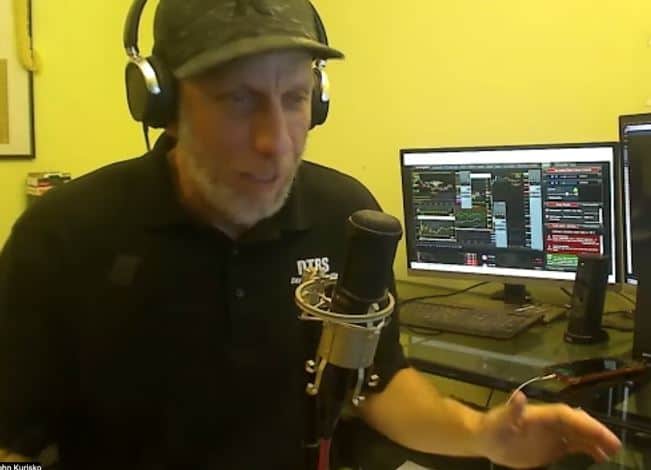
John Kurisko is a veteran futures day trader and longtime voice behind DayTradingRadio, known for turning market noise into a clear, rules-driven process. In this interview, John breaks down how he trades the S&P 500 micros (MES), why momentum and divergence are his north star, and how a written “business plan” keeps him from overtrading. If you care about real-world execution—entries, exits, and the mindset to stick to them—this conversation shows why John matters to active traders.



You’ll learn John Kurisko’s core strategy principles—waiting for high-probability setups, aligning trades with momentum (not against it), and scaling a small account using micro futures without falling into the pattern day trading trap. He explains how to spot and act on stochastic-based divergences, why strict discipline beats constant tinkering, and how pre-planning entries, stops, and targets turns you into a “trading robot” when it counts. If you’ve been chasing moves or second-guessing exits, John’s approach will help you slow down, focus on just a few repeatable setups, and execute with confidence.


















John Kurisko Playbook & Strategy: How He Actually Trades
What He Trades and Why It Fits His Edge
John focuses on the S&P 500 futures, especially the micros (MES), because they’re liquid, clean, and let you size precisely while keeping emotions in check. This section shows how he frames the instrument and the sessions he respects, so you can copy the structure without guesswork.
- Trade MES/ES during U.S. cash hours with priority on the first 2–3 hours and the last hour.
- Avoid trading around major data for five minutes before and after, unless pre-planned.
- Use MES to scale in/out while keeping total ES-equivalent risk constant.
- Keep a single “home” product most days; only add NQ/CL if your A+ setup appears there.
His Charting Stack (Keep It Simple, Repeatable)
He keeps charts minima, so the same pattern “pops” every day. You don’t need twenty indicators—just enough to define momentum, exhaustion, and structure.
- Primary timeframe: 5 minutes for entries, 15 minutes for structure,1 minute for precision.
- Plot VWAP, prior day high/low, overnight high/low, session open, and a 20-EMA.
- Use Stochastic (14,3,3) and RSI (14) for momentum/divergence; hide anything you don’t use.
- Keep DOM/T&S visible only if it helps execution; never let it override the setup.
A+ Setup: Momentum Divergence Into a Known Level
This is the bread and butter: exhaustion momentum into VWAP or a key swing level, confirmed by divergence and a clean reversal trigger. Learn it cold, trade it mechanically.

- Context first: price pushes into VWAP, prior day levels, or a 15-minute swing with extended 5-minute Stochastic.
- Require momentum divergence (price makes a marginal new high/low while Stochastic/RSI fails).
- Candlestick trigger: 5-minute reversal close (engulfing/pin) back inside the 20-EMA or off VWAP.
- Entry: stop order 1 tick beyond the trigger candle; no limit “hoping” fills.
- Invalidation: 1 ATR(14, 5-min) beyond the extreme of the setup candle or the key level—whichever is closer.
- Target 1: fixed 1R; Target 2: next structure/VWAP/IB edge; leave a trailer for trend days.
- Cancel setup if price chops >20 minutes without progress or if news is imminent.
Trend Alignment and When to Stand Down
He trades with the day’s dominant impulse. Counter-trend trades exist, but only if the level + divergence is undeniable. If nothing lines up, he skips.
- Define day bias by 15-minute swing structure and VWAP relationship; above rising VWAP = long bias, below falling VWAP = short bias.
- Pass on counter-trend signals unless they print at HTF levels with strong divergence and a decisive reversal close.
- If three consecutive valid setups fail in a session, reduce the size by 50% or stop for the day.
- Don’t fade a trend day, making higher highs/lows above VWAP—wait for pullbacks to the 20-EMA/VWAP and take continuation.
Risk, Size, and Scaling Rules
Sizing is math, not mood. He fixes risk per trade and uses micros to ladder in and take profits without changing the plan.
- Daily max loss: 2R; weekly max loss: 6R; hit either and stop trading.
- Per-trade risk: 0.5R–1R depending on quality (confluence = 1R, light confluence = 0.5R).
- Scale in only if the same signal repeats (e.g., second divergence at the level) and never increases total risk beyond 1R.
- Partial out at 1R (take 50%); move stop to breakeven +1 tick after partial.
- For trailers, use a 5-minute swing stop or a 20-EMA close against the position.
Pre-Market Prep: Build the Map
He starts every day with a simple ma,p so execution is just following directions. Your plan should fit on a sticky note.
- Mark: prior day H/L, overnight H/L, session open, yesterday’s VWAP, and any 15-minute swings.
- Write two if-then lines for both long and short scenarios (“If price rejects VWAP with bearish divergence → short back to open/IB”).
- Identify the A+ level where you’ll allow the first trade; ignore the middle of the range.
- Note scheduled news; set alerts 10 minutes before release.
Execution Checklists (Before, During, After)
Checklists remove hesitation. You either have the boxes checked or you don’t—no debate.
- Pre-trade: (1) Level tagg, ed (2) Divergence present (3) Reversal close (4) ATR-based stop defined (5) Targets noted.
- During trade: announce to yourself “1R partial, trail by 5-min swing, stop to BE after partial.”
- After trade: log setup quality (A/B/C), adherence (Y/N), and emotional state (1–5).
- If you deviate from the plan twice in a session, end the session; review and write the fix.
Managing Chop vs. Trend Days
Not every day is designed for home runs. He uses simple heuristics to decide if today is a “take singles” day or a “let it run” day.
- If the first hour forms a balanced Initial Balance (IB) with VWAP centered, take singles and exit at structure.
- If price breaks IB with strength and holds above/below VWAP, let runners work and trail by 5-minute swings.
- Three failed range breaks = treat day as chop; reduce size by 25% and favor mean-reversion at edges.
- On confirmed trend days, skip fading VWAP; trade pullbacks in the trend only.
Add-Ons and Do-Nots
Refinements help—but only if they’re systematic. Here’s what he allows and what he bans.
- Allowed add-ons: second divergence at the same level, pullback to 20-EMA after initial reversal, or retest of VWAP with fresh rejection.
- Prohibited: averaging down, moving stops away, adding size without a new signal, or chasing after a missed trigger.
- If slippage exceeds planned risk by >0.3R twice in a day, cut size in half or stop trading that session.
Journal and Metrics That Actually Matter
He tracks what improves expectancy, not vanity metrics. Keep it tight and actionable.
- Record: setup type, level confluence count (0–3), divergence quality (0–2), R multiple, and adherence (Y/N).
- Weekly review: win rate by setup, average R by time of day, slippage vs. news windows.
- Cut any setup with <0.3R average over 20 occurrences; double down on the top two performers.
- Screenshot pre-trade context and post-trade outcome; annotate mistakes and fixes in plain English.
Mindset and Session Discipline
He treats the session like a job with a clock-in, clock-out, and a script. Discipline is the edge that survives regime shifts.
- Start with two “breathing reps” before the open; end with a 5-minute debrief no matter what.
- First trade must be A+ only; no warm-up scalps.
- If you feel the urge to “make it back,” step away for 10 minutes and re-read the plan.
- Stop after 2R up or 2R down—protect emotional capital for tomorrow.
Playbook in One Look (How to Press the Button)
When the picture matches, you act. When it doesn’t, you wait. That’s the whole game.
- Wait for price to stretch into VWAP/PDH/PDL/15-min swing with extended Stochastic.
- Confirm divergence and a clear 5-minute reversal close.
- Enter with a stop order beyond the trigger; place a stop at 1× ATR beyond the extreme.
- Take 50% at 1R, move stop to BE+1 tick, trail remainder by 5-minute swings to structure or into the close.
- If it doesn’t move within 20 minutes or news is due, scratch or reduce exposure.
Size Risk First: Fixed R, Micros for Precise Scaling and Control
John Kurisko starts by locking in a fixed R per trade so outcomes are measured, not guessed. He treats the MES position size as a dial to match that R, never the other way around. By defining stop distance first, his size floats to keep the dollar risk constant across different volatility regimes. That keeps him steady on choppy days and calm when ranges expand.
He also scales using micros only when the same signal repeats, not to average down a mistake. Partial profits are taken mechanically at 1R, with the stop bumped to breakeven to protect the rest. This converts a good entry into a stress-free runner while honoring the original risk math. For John Kurisko, the discipline is simple: fix R, let size adapt, and let the strategy—not emotion—decide when to press or stand down.
Trade the Level, Not the Noise: Momentum Divergence with VWAP Confluence
John Kurisko waits for price to stretch into a mapped level—VWAP, prior day high/low, or a clean 15-minute swing—before he even considers a trigger. He wants momentum divergence there: price pokes the level while Stochastic or RSI refuses to confirm, signaling exhaustion. The reversal isn’t a guess; he looks for a decisive 5-minute close back through the 20-EMA or away from VWAP to prove the turn. By anchoring to known levels, John Kurisko filters out mid-range chop that chews up traders.
Entries are placed with stop orders just beyond the trigger candle, so the market must move in his direction to fill him. If the divergence fades or news is imminent, he cancels the idea—no “hope trades.” Stops sit about one ATR beyond the extreme to avoid random shakeouts, and first profits come at 1R before a trailer takes over. The whole point is consistency: trade the level with momentum confirmation, or do nothing.
Let Mechanics Rule Over Predictions: If-Then Plans and Checklists Win
John Kurisko doesn’t care about calling tops; he cares about following scripts. Before the open, he writes simple if-then statements—“If price rejects VWAP with bearish divergence, then short to the open”—so execution is just matching pictures, not forecasting. He reads the tape only to confirm the plan, never to improvise a new one mid-trade.
During the session, John Kurisko ticks through a checklist: level tagged, divergence present, reversal close, ATR stop defined, and targets noted. If one box isn’t checked, he passes—no “it looks good enough” trades. After each trade, he logs adherence first and P&L second; a green trade that broke rules is flagged as a loss of discipline. The takeaway is blunt: mechanics beat opinions, and the trader who follows a repeatable script wins the week.
Volatility Guides Targets and Stops: ATR-Based Exits, Trailing When Trend Persists
John Kurisko lets volatility set the boundaries so his risk and targets adapt to the day, not the other way around. He sizes the stop using a multiple of ATR from the trigger candle’s extreme, giving the trade enough room to work without drifting into “hope.” Targets flex too: a fixed first take at 1R, then a volatility-informed objective at the next structure or VWAP band. When ATR is elevated, he expects faster moves and gives the runner more leash; when ATR compresses, he tightens expectations and takes singles.
Once the first profit is booked, John Kurisko moves the stop to breakeven and shifts to a trailing logic that respects the 5-minute swings or a close through the 20-EMA. This keeps him aligned when the market trends and quietly exits him when momentum fades. The rule is simple and repeatable: volatility defines risk, price action validates direction, and the trailer harvests the rest. It’s a clean way to avoid guessing tops and bottoms while still pressing your winners when the tape opens up.
Diversify by Time and Tactics: Open Drive, Reversal, and Pullback Plays
John Kurisko splits the session into distinct opportunity windows and assigns tactics to each. In the first hour, he’s ready for open-drive continuation if price holds above or below VWAP with strong breadth; midday, he shifts to reversal hunting at prior extremes; late day, he favors pullbacks into VWAP for a push into the close. By matching tactics to time-of-day behavior, he avoids forcing one setup onto every tape and keeps expectancy stable.
He treats diversification as rotating among three proven plays—not adding random indicators. For John Kurisko, the open drive is a momentum permission slip, the reversal demands divergence and a decisive rejection, and the pullback requires trend alignment plus a clean trigger back through the 20-EMA. If one lane goes cold, he moves to the next without increasing risk; the edge comes from patience and fit, not prediction. The result is a simple rule: choose the tactic the market is offering right now, and let time of day narrow your options before you press the button.
John Kurisko’s core message is simple: pick a repeatable edge, plan it like a business, and let disciplined execution do the heavy lifting. He leans on momentum divergences to time turns, prefers the S&P 500 micros (MES) so sizing stays precise for smaller accounts, and avoids getting tangled in macro debates that don’t move his entries or exits. The playbook revolves around a mapped level, a momentum tell (stochastic/RSI divergence), and a clean trigger—then ATR-based risk and mechanical scaling take over.
What sets John apart is how deliberately he keeps things beginner-friendly without dumbing them down. He spells out the advantages of MES for traders below the pattern day trading threshold, shows how to “buy time” with precise micro sizing, and stresses that consistency beats prediction. The mindset is front and center: treat the session like a job, accept that the market can be “schizophrenic,” and step back when conditions feel wrong rather than forcing a narrative. His advice folds into a practical business plan—contracts, first targets, add rules, and scale-up logic are predetermined, so execution mostly follows instructions.
Finally, John shows traders how to adapt when markets trend versus chop. In strong trends, he favors a simple “20/20 flag” concept: price holding above the 20-EMA with a fast, embedded stochastic on the lower timeframe—proof to press continuation rather than fade it. When conditions shift, he goes back to patience, waiting for divergence at a real level instead of nibbling mid-range noise. The throughline is discipline: fewer setups, clearer rules, better expectancy. Learn the tells, trade the plan, and let the math—not emotion—compound.